
If you have spent any time in the B2B tech space recently, you have probably noticed a shifting tide. For years, the “growth at all costs” mantra meant that Marketing and Sales were the stars of the show, while Customer Success (CS) was often relegated to a reactive “firefighting” role. But as we navigate 2026, the data is clear: retention is the new acquisition.
I have seen this firsthand in my work. Whether I’m managing accounts or researching social policy, the principle remains the same: you cannot sustain a system if the foundation is leaking. In the SaaS world, that leak is churn. We often treat Marketing and CS as two different islands, but that gap is where revenue goes to die. To truly protect your base, you need a Content Loop, a continuous cycle where CS insights fuel Marketing assets, and Marketing assets empower CS to drive deeper adoption. Here is why this alignment is your most potent retention weapon this year.
The Broken Handoff Between Marketing and Customer Success
Traditionally, the relationship between Marketing and Customer Success has been defined by a handoff. The process often looks like this:
| Stage | Responsible Team | Typical Output |
| Lead generation | Marketing | Campaigns, webinars, ads |
| Deal closing | Sales | Contracts, pricing |
| Customer onboarding | Customer Success | Implementation, training |
Once the contract is signed, Marketing typically shifts attention to the next prospect. This creates what many operators describe as an experience cliff.
During the buying process, prospects encounter polished messaging, case studies, and high-quality educational content. After the deal closes, the experience often changes abruptly, customers receive product documentation, support tickets, and technical onboarding guides.
The result is a disconnect between expectations and reality. Customers may still value the product, but they struggle to translate its features into meaningful business outcomes. This gap frequently becomes visible within the first 90 days of adoption, the most critical window for long-term retention.
Why Net Revenue Retention Now Drives Strategy
The increasing importance of Net Revenue Retention has changed how companies evaluate Customer Success. NRR measures how much revenue a company retains from existing customers after accounting for:
- Renewals
- churn
- upgrades
- expansion revenue
High-performing SaaS companies typically maintain NRR above 110–120%, meaning existing customers generate more revenue each year through expansion than they lose through churn.
The connection between Customer Success and Marketing becomes clear when examining how retention actually improves. Companies rarely increase NRR simply by improving support operations. Instead, retention improves when customers clearly understand how to extract value from the product. That learning process is where marketing-quality content becomes essential.
What a Content Loop Actually Is
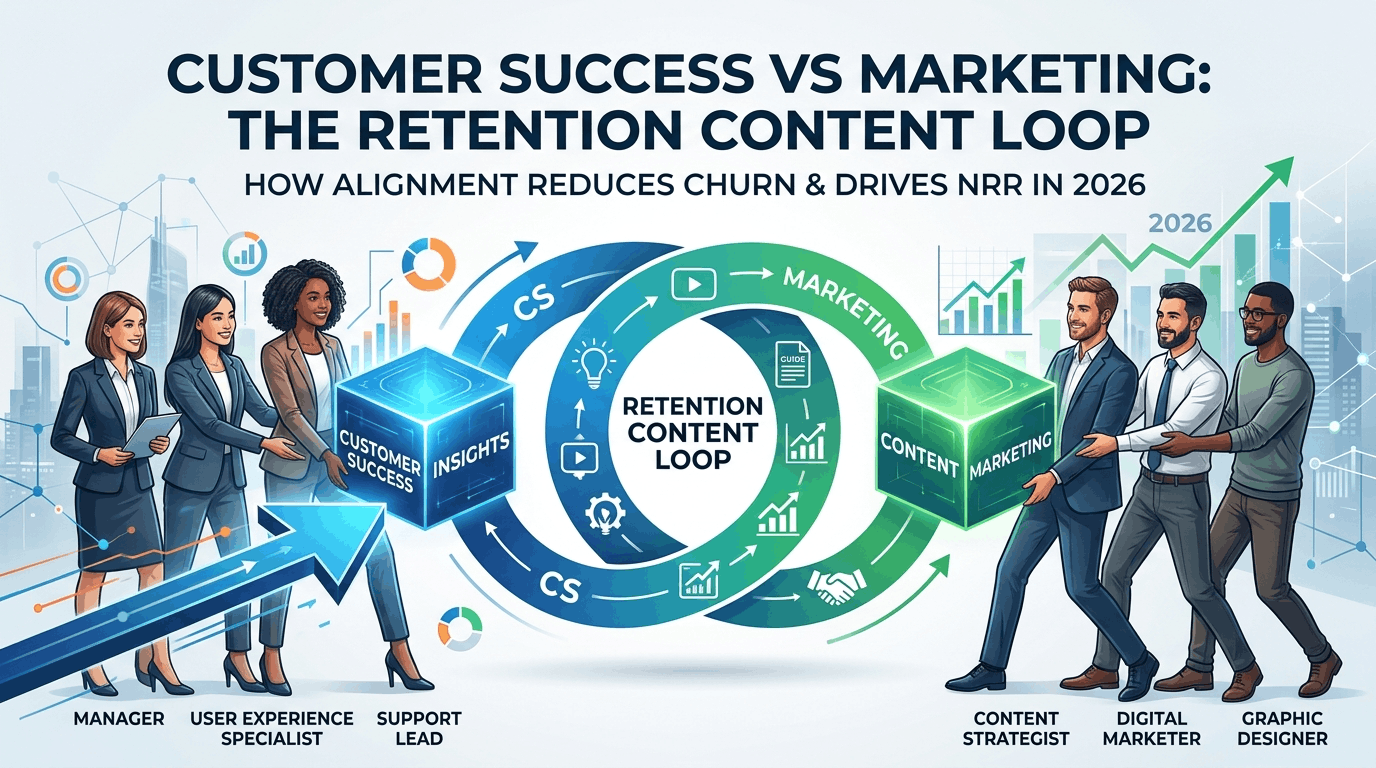
A Content Loop is a structured process where insights from Customer Success continuously inform marketing content, and marketing content helps Customer Success drive customer outcomes.
Instead of treating post-sale knowledge as operational data, companies treat it as strategic input. The loop typically follows three steps.
1. Insight Collection
Customer Success teams identify recurring patterns during onboarding and account management. Common signals include:
- frequently asked questions
- feature confusion during onboarding
- adoption bottlenecks
- workflow friction
These insights represent real problems customers are trying to solve.
2. Content Creation
Marketing transforms these operational insights into structured assets such as:
- implementation playbooks
- short tutorial videos
- workflow guides
- benchmark reports
These assets translate product features into business outcomes.
3. Customer Distribution
Customer Success uses these materials during key moments in the customer lifecycle. Examples include:
- onboarding sequences
- quarterly business reviews
- feature adoption campaigns
Each interaction reinforces the value of the product while reducing confusion.
Why Content Loops Improve Retention
Customer education plays a significant role in retention outcomes. Research across SaaS companies consistently shows that customers who understand how to use a product effectively are significantly more likely to renew. The impact of structured educational content is measurable.
| Retention Metric | Impact of Strong Customer Education |
| Retention rate | Up to 29% improvement |
| Churn reduction | Around 15% decrease |
| Knowledge retention | ~60% improvement with multimedia learning |
| Cost-to-serve | 20–30% reduction through self-service content |
These improvements occur because customers no longer depend solely on support teams for answers. Instead, they gain access to resources that help them succeed independently. This creates a reinforcing cycle: better education leads to higher adoption, which leads to stronger retention.
Building a Content Loop: Three Structural Components
Companies that successfully implement a Content Loop typically rely on three structural practices.
1. Structured Customer Insight Collection
Customer Success teams interact with customers daily, but those insights often remain trapped inside meeting notes or CRM systems. Effective organizations create a consistent process for capturing these insights. Examples include:
- weekly CS insight reviews
- onboarding friction reports
- support ticket pattern analysis
The goal is simple: convert recurring customer problems into documented learning opportunities.
2. Targeted Educational Content
Not all content contributes equally to retention. The most effective educational content focuses on practical workflows rather than product features. Common high-impact formats include:
- short implementation tutorials
- industry-specific playbooks
- role-based onboarding guides
For example, a product used by both operations managers and executives might require entirely different learning resources for each role. When customers can quickly identify the material most relevant to their responsibilities, adoption accelerates.
3. Lifecycle-Based Distribution
Content becomes significantly more valuable when delivered at the right moment. Instead of relying on static help centers, companies distribute content according to the customer lifecycle. Typical distribution moments include:
- onboarding milestones
- first feature adoption attempts
- quarterly review meetings
This approach ensures that educational resources arrive precisely when customers need them.
Case Study: Addressing Adoption Gaps in a Complex Product
To understand how a Content Loop functions in practice, consider a real challenge faced by many enterprise platforms: adoption decline after onboarding. In one enterprise IT staffing environment, customer accounts showed a consistent pattern. Clients were enthusiastic during implementation and early training sessions, but product engagement declined several weeks later.
Usage data revealed that customers were not abandoning the platform entirely. Instead, they were using only a limited subset of its capabilities. A deeper review of Customer Success conversations revealed the underlying issue.
Many customers understood the product’s core functions but struggled to connect its analytics tools with the reporting expectations of their own executive teams.
The Content Loop Intervention
Instead of treating the issue as a training problem, the company introduced a structured Content Loop. The process involved three steps.
- Customer Success insight:
Account managers documented recurring requests from customers seeking guidance on how to present platform data during executive reviews.
- Marketing content creation:
Marketing developed a structured resource explaining how platform analytics could be translated into operational performance reports. This included:
- reporting templates
- example executive summaries
- short walkthrough videos
- Customer Success distribution: CS teams incorporated the new resources into onboarding follow-ups and quarterly business review preparation.
The Result
Within several weeks, engagement with the analytics features increased significantly. More importantly, customers began using the platform during internal decision-making processes rather than treating it as a passive data repository. The intervention worked because the company addressed a strategic workflow gap, not simply a product usability issue.
Why Marketing Needs Customer Success Data
Marketing teams often struggle with a fundamental challenge: identifying which messages resonate most strongly with real users. Traditional marketing research methods: surveys, focus groups, and analytics, offer valuable insights but can miss operational realities.
Customer Success teams encounter those realities daily. Examples of insights CS teams observe regularly include:
- the moment when customers first recognize product value
- the features customers misunderstand most often
- the workflows that produce measurable results
These insights represent valuable content opportunities. When Marketing has access to this knowledge, it can produce materials that resonate not only with prospective buyers but also with existing customers.
Aligning Teams Around Net Revenue Retention
For Content Loops to work effectively, Customer Success and Marketing must share at least one core performance metric. Increasingly, that metric is Net Revenue Retention.
When Marketing teams focus exclusively on new leads, retention content often receives lower priority. But when both teams share responsibility for revenue expansion within existing accounts, incentives change. Marketing begins producing more resources aimed at:
- product adoption
- customer education
- expansion opportunities
This alignment transforms marketing content from a purely acquisition tool into a long-term revenue asset.
Practical Steps to Launch a Content Loop
Organizations do not need large teams or sophisticated technology stacks to begin implementing this model. Several simple operational changes can establish the foundation.
Step 1: Identify Key Adoption Moments
Customer Success teams should identify the specific actions that correlate most strongly with long-term retention.
Examples may include:
- completing onboarding workflows
- activating advanced features
- integrating the product into core business processes
Marketing content should support these milestones.
Step 2: Create a Content Request Channel
Customer Success teams need a simple mechanism to request educational resources. This can be as simple as a shared request tracker documenting:
- recurring customer questions
- feature adoption barriers
- requested learning materials
This process ensures marketing content responds directly to real customer needs.
Step 3: Deliver Content Through Lifecycle Campaigns
Instead of relying on static help centers, companies should integrate educational content into automated lifecycle communications. Examples include:
- onboarding email sequences
- milestone notifications
- renewal preparation campaigns
These touchpoints ensure content reaches customers at moments of highest relevance.
The Strategic Advantage of a Content Loop
The growing importance of Net Revenue Retention has reshaped how companies evaluate growth. Acquiring customers remains essential, but sustainable revenue increasingly depends on keeping existing customers engaged and successful.
Organizations that integrate Customer Success insights into marketing content gain several advantages:
- clearer product value communication
- faster customer adoption
- stronger renewal rates
- improved expansion opportunities
These outcomes ultimately translate into higher NRR. In a market where acquisition costs continue to rise, retention has become one of the most reliable sources of competitive advantage. Companies that build structured Content Loops between Customer Success and Marketing position themselves to capture that advantage, turning customer knowledge into the most powerful growth asset they possess.
The Competitive Moat of 2026
The “Customer Success vs. Marketing” debate is over. In a market where capital is expensive and acquisition costs have risen by 30% over the last three years, you cannot afford to have a fragmented customer journey.
A content loop is more than just a workflow, it is a competitive moat. It ensures that your customers are constantly reminded of the value you provide, educated on how to use your tools more effectively, and connected to a community of peers who reinforce their decision to stay with you.
I learned that the most effective strike isn’t the one with the most force, but the one with the best timing and alignment. The same is true for your retention strategy. Stop trying to “force” renewals at the 11th hour. Instead, align your teams today, build your content loop, and let the value speak for itself.
Key Takeaways for 2026
- Retention now drives growth: Net Revenue Retention has become one of the most important metrics in modern SaaS companies.
- Customer Success insights are underused: Frontline customer knowledge often reveals the most valuable opportunities for content.
- Content Loops close the adoption gap: When Marketing transforms CS insights into educational resources, customers learn faster and churn less.
- Alignment between teams is critical: Shared retention metrics ensure that both Customer Success and Marketing focus on long-term customer value.