
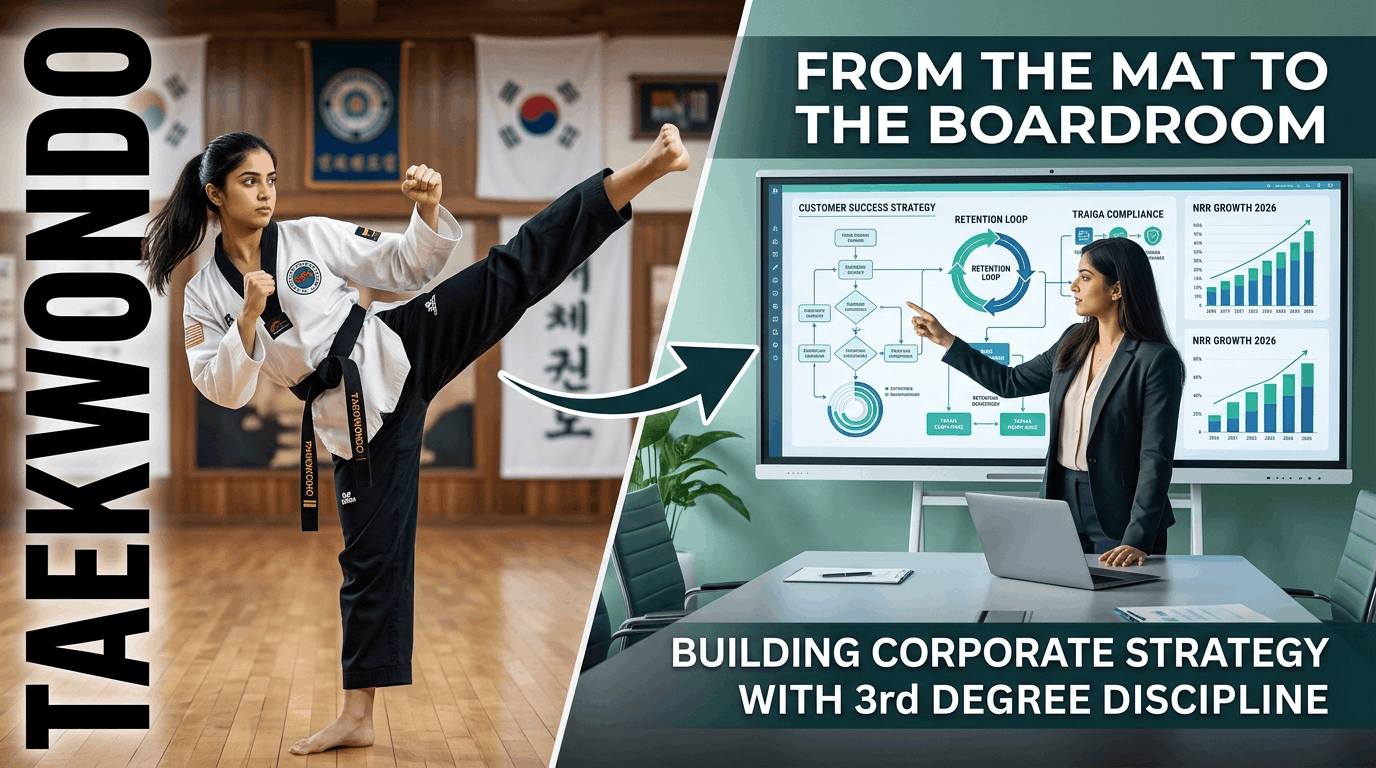
If you look at my résumé, you will see the standard trajectory of an early-career professional in Tech. You will see roles in Customer Success, Marketing, and references to Agile methodologies. You will also see my academic background from Columbia University and Brandeis, where I focused heavily on Social Justice, Legal Studies, and Political Science. On paper, it looks like a calculated pivot from policy research into the corporate arena. But there is one line item, often tucked away near the bottom, that people frequently overlook, or treat as a mere conversation starter.
It simply says: “3rd Degree Taekwondo Black Belt and 4x State Gold Medalist.”
Those are not just trophies on a shelf. The reality is that the decade I spent on the dojang mat, enduring rigorous training, facing opponents, and mastering complex forms, was arguably the single most important preparatory experience for my career. The lessons I learned, about discipline, strategic foresight, and resilience, did not stay at the gym. They are the same principles I apply today when I am mapping out customer success functions, designing marketing alignment strategies, or navigating complex organizational challenges in the tech sector. Taekwondo was not just a sport; it was my foundation for corporate strategy.
Moving Beyond the “Karate Kid” Cliché: Discipline as Infrastructure
When I mention martial arts in a professional setting, people often default to Hollywood imagery. They visualize dramatic movie kicks, wood-breaking demonstrations, or the cliché of “finding your inner peace.” And, yes, there is an element of that. But the foundational reality of a decade in Taekwondo is far more rigorous, and often far less glamorous.
In Taekwondo, discipline is not just about following rules. It is about fundamental consistency. It is the commitment to show up, regardless of whether you are tired, whether it is raining, or whether you feel motivated. It is about the hundreds of repetitions required to master a single “form” or kick. It is that precise dedication to the “little things” that eventually translates into high-level performance. You do not wake up one day and become a black belt. You earn it through thousands of small, disciplined actions.
From the Dojang Mat to the Customer Success Playbook
How does this translate to corporate strategy, especially early in your career? It means understanding that strategy, too, is built on an infrastructure of consistency.
A few years ago, I was tasked with helping design a customer onboarding playbook. The goal was simple: reduce customer churn and drive long-term retention. However, it is never that simple in execution. We could not just “implement a strategy” and expect instant results.
The true breakthrough came when I applied the Taekwondo mindset of incremental, disciplined repetition to the problem. We had to focus on the boring, repetitive, granular tasks that make up a client relationship. This meant:
- Audit Consistency: We didn’t just guess why clients left. We rigorously (and repetitively) audited every single client touchpoint for an entire quarter.
- Documentation Discipline: We moved away from ad-hoc responses and mandated that every “success step” (those moments of client alignment) be meticulously documented in a centralized database, not just for compliance, but for pattern recognition.
- The Power of Small Wins: Just as a complex form is broken down into individual movements, we broke down the large goal of “retention” into tiny, manageable “forms,” such as the first 48 hours of onboarding, the first 30-day health check, and the first success metric review.
By implementing this disciplined approach to the small, repetitive “forms” of the customer journey, we were able to build a cohesive, resilient strategy. We weren’t looking for cinematic knockout kicks but we were perfecting the foundation.
This disciplined process allowed us to identify subtle signs of client friction that a less structured approach would have missed entirely. When you understand that strategy is built on repetitive, disciplined execution, you realize that the most “boring” parts of your process are often the most critical foundations for your greatest successes.
The Strategy of the Sparring Ring: Anticipation and Agility
In the world of 2026, where corporate strategy is no longer a static five year plan but a living, breathing organism, the lessons from the sparring ring are more relevant than ever. When I stepped onto the mat for a competitive match, I wasn’t just thinking about my own moves. I was hyper-aware of my opponent’s breathing, their footwork, and the slight shift in their weight that signaled an incoming attack. This is “active anticipation.”
In Taekwondo, if you wait for the kick to land before you react, you’ve already lost. You have to read the intent behind the movement. Corporate strategy in the tech sector operates on the exact same frequency. Whether I am analyzing market shifts in Houston real estate or looking at how AI regulation might disrupt a client’s workflow, I am looking for the “tell.”
Case Study: Navigating the 2026 AI Regulatory Shift
Recently, I’ve been applying this sparring mindset to the intersection of AI and Law. With the full implementation of the Texas Responsible AI Governance Act (TRAIGA) earlier this year, many of our partners were caught off guard. They saw it as a hurdle: a “kick” they didn’t see coming.
However, by using the strategic foresight I honed as a 3rd-degree black belt, I helped reframe this for our team. We didn’t just wait for compliance deadlines. Instead, we practiced:
- Distance Management: In sparring, you control the space. In business, this means staying far enough ahead of legislation that you aren’t backed into a corner. We initiated “Reasonable Care Impact Assessments” months before the January 1st deadline.
- The Counter-Attack: Instead of just “surviving” the new regulations, we used our early compliance as a marketing differentiator. We turned a legal requirement into a Customer Success “win” by proving to our clients that their data was safer with us than with less-prepared competitors.
- Feinting and Pivoting: Sometimes a strategy doesn’t work. In Taekwondo, if a roundhouse kick is blocked, you don’t keep jamming your leg into their guard. You pivot. You change levels. When a specific marketing campaign isn’t hitting the right KPIs, we don’t double down out of ego, we pivot the messaging with the same fluidity I would use to switch from a high kick to a clinching maneuver.
Resilience and the “Tenets of Taekwondo” in the Boardroom
The five tenets of Taekwondo are Courtesy, Integrity, Perseverance, Self-Control, and Indomitable Spirit. While they sound like something you’d find on an inspirational poster, they are actually the “soft skill” requirements for modern leadership.
Take “Indomitable Spirit.” In the context of a 3rd-degree black belt, it means getting back up after a 4x State Gold Medalist streak is broken by a humbling loss. In the context of a Customer Success Manager at an IT staffing firm, it means keeping your cool when a high-value account is at risk due to external market volatility.
Building a “Health Score” for Personal and Professional Resilience
I often think about “Customer Health Scores” in the same way I think about my physical readiness for a tournament. You cannot improve what you do not measure. In the corporate world, we often wait until a “break” happens to fix the system.
| Taekwondo Metric | Corporate Strategy Equivalent | 2026 Impact |
| Cardiovascular Endurance | Operational Cash Flow / Burn Rate | Ensures the “stamina” to outlast market downturns. |
| Flexibility (Range of Motion) | Agile Methodology Adoption | Allows the team to stretch into new markets without breaking. |
| Precision of Technique | Data Accuracy in CRM/Marketing | Prevents “wasted energy” on the wrong target audiences. |
| Mental Focus | Brand Voice & Core Values | Keeps the company from chasing “shiny object” trends that dilute the mission. |
The Power of the “Black Belt Mindset” in Early Career Growth
One of the biggest challenges for early-career professionals, especially those of us coming from multi-dimensional backgrounds like Political Science and Sociology, is the “imposter syndrome” of entering the tech space. But being a black belt taught me that the belt is just a piece of cloth that covers your stomach; it’s the work behind it that matters.
When I was at Columbia and Brandeis, I wasn’t just studying policy; I was studying how systems fail and how they can be rebuilt. When I moved into Customer Success, I realized that a business is just another complex system. My “3rd-degree discipline” gave me the confidence to walk into rooms with senior stakeholders and speak with authority, not because I knew more about their specific niche, but because I knew how to apply a rigorous, disciplined framework to any problem they threw at me.
Mastering the Long Game: Strategy as a Black Belt Journey
If there is one thing that a decade in martial arts teaches you, it is that there is no such thing as “done.” You don’t “finish” Taekwondo when you get your black belt; you simply begin a more advanced level of practice. In 2026, corporate strategy feels remarkably similar. The market doesn’t stay still, and the “opponents”, be they economic shifts, new competitors, or rapid-fire technological changes, are always growing.
One of the most profound realizations I’ve had as a Customer Success Manager is that the most successful clients aren’t the ones who make the biggest initial splash. They are the ones who treat their business operations with the same “White Belt” humility I had to maintain for years. They are constantly refining their basics.
Example: The “Houston Market” Strategy
Take my interest in the Houston real estate market. In 2026, Houston has become a “safety net” for Gen Z wealth builders because of its relative affordability compared to Austin. But a “Black Belt” investor doesn’t just buy a property and hope for the best. They apply a disciplined strategy:
- The 6% Benchmark: With mortgage rates stabilizing around 6.0% this year, the strategy isn’t about timing the bottom, it’s about Cash Flow Precision.
- Data-Driven Defense: Just as I would check my guard in a match, a smart investor in 2026 checks the construction permits in their zip code to ensure supply isn’t going to dilute their equity.
- The Pivot: If the rental market softens, do you sell? No. You pivot to mid-term corporate housing for the booming Texas tech sector. That is “Indomitable Spirit” in a financial context.
Conclusion: Why Every Leader Needs a “Mat”
As I look at where my career is headed, at that intersection of Customer Success, Marketing, and the legal complexities of AI, I realize that my degree from Columbia gave me the “what,” but Taekwondo gave me the “how.” It gave me the ability to sit in a boardroom and remain calm when a project goes sideways. It gave me the resilience to hear “no” from a prospect and see it not as a rejection, but as a repositioning.
Corporate strategy is often presented as a series of spreadsheets and slide decks. But at its core, it is a human discipline. It requires the courage to step onto the mat, the focus to execute under pressure, and the integrity to stay true to your values when things get difficult.
Whether you are building a Customer Success function from scratch or navigating the nuances of the 2026 Texas AI laws, remember that you are in training. Every challenge is a repetition. Every setback is a lesson in balance. And every win? That’s just a sign that it’s time to tighten your belt and get back to work.
Key Takeaways for the 2026 Professional
- Consistency over Intensity: You can’t cram for a black belt, and you can’t “hack” a long-term business relationship.
- Anticipate the “Kick”: Use regulatory shifts (like TRAIGA) as a strategic advantage, not just a compliance checkbox.
- Master the Basics: High-level strategy is just the basic forms executed with 100% precision.
Let’s Connect and Grow
I’m currently focused on helping B2B tech firms align their Customer Success and Marketing engines to drive actual, measurable growth. If you’re interested in how we can apply these disciplined frameworks to your retention strategy, or if you just want to talk about the best places to train in Houston, let’s chat.